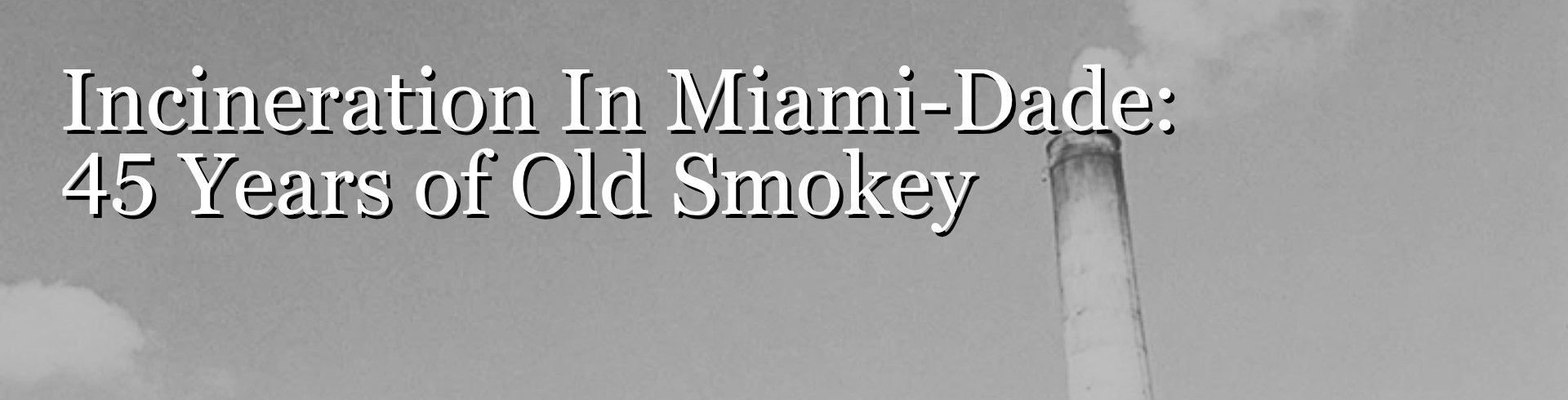
1925 – “Old Smokey,” Miami-Dade’s first solid waste incinerator, begins operating in West Coconut Grove, a predominantly black community.
1930s-40s – Residents of the West Grove filed multiple complaints and requests to shut down Old Smokey, all of which were ignored.
1950s-60s – Old Smokey was renovated to be “state of the art” and create a “smokeless and odorless” incinerator.
It became worse, with smoke and ash blanketing residences in the City of Coral Gables.
This led to the City of Coral Gables suing the City of Miami over Old Smokey.
1975 – After decades of releasing countless tons of toxic ash from its furnace into nearby schools, parks, and residences, it was shut down as a public nuisance by court order.
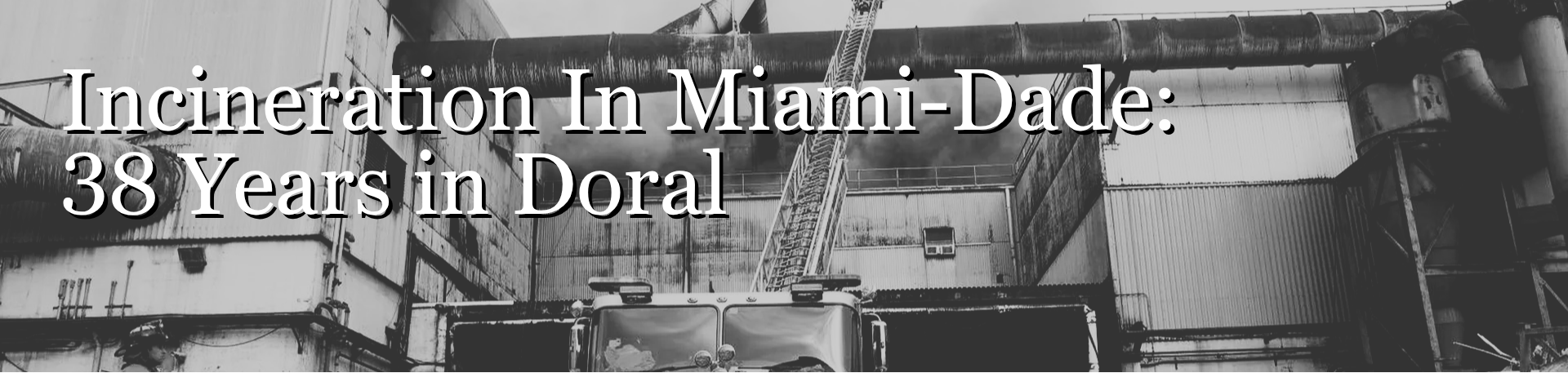
1982 – A new waste incinerator in Doral officially opens.
1985 – The Doral incinerator begins commercial operations.
2003-2008 – The incinerator is cited by DEP for violations in 2003, 2006, 2007, & 2008.
2011 – Contaminated soil was discovered at multiple parks surrounding Old Smokey, resurfacing the impact of 45 years of incineration still felt to this day by West Grove residents.
2013 – Researchers at the University of Miami find cluster of pancreatic cancer cases in the West Grove, believed to be linked to high concentrations of arsenic in drinking water.
2014-2022 – Released 6,692,87630 MTCO2e into our communities & the atmosphere.
2017 – Present – The Downs Law Group is currently representing nearly 900 Coconut Grove and Coral Gables longtime residents who have health conditions that may be linked to ‘Old Smokey.’
2023 – The incinerator burns down for over 3 weeks due to a fire on a conveyor belt and (known) faulty safety mechanisms, leading to the release of countless toxins into Doral and the county.
2024 – Miami-Dade County proposes building a new waste incinerator, with 4 different sites as potential locations, including Doral and Miramar.
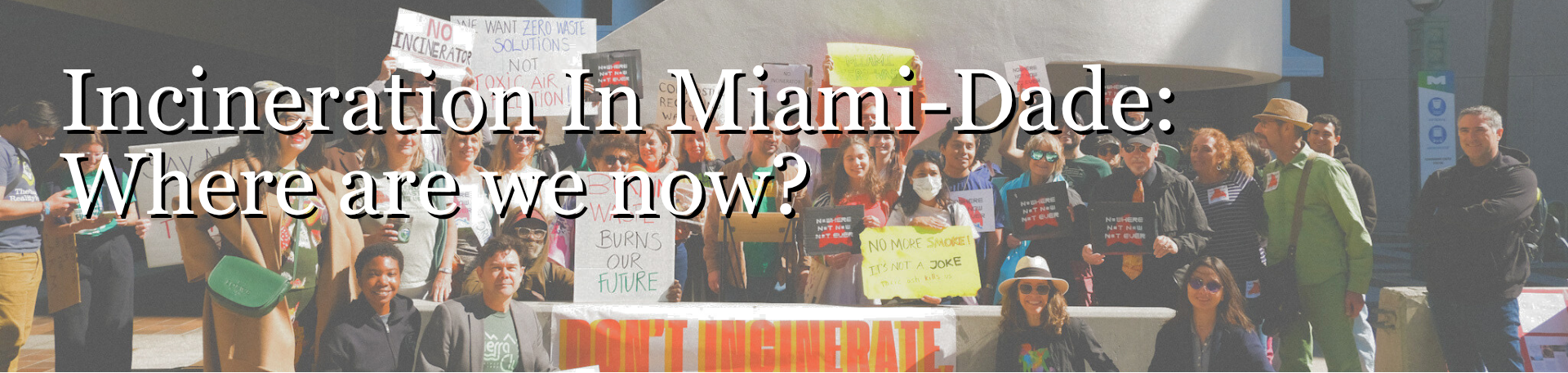
July 16, 2025 – The Don’t Incinerate, Innovate! Coalition packed the County Commission chambers to demand a better path forward. The Board responded by voting to:
- Direct the Mayor to return in mid-October with a final site recommendation—if any.
- Eliminate 3 of 4 proposed incinerator sites, leaving only the controversial Okeechobee land-swap deal still under review.
- Require that 40% of county waste be managed without burning.
- Establish a ½-mile residential buffer zone around all future waste sites.
October 21, 2025 – The County is negotiating potential plans for a new incinerator with two different waste management companies, FCC and Covanta (through a collaboration with FP&L).
July 2025 – Mayor’s report on the options available for the future of solid waste disposal in Miami-Dade
On July 16, Miami-Dade County commissioners voted to replace the trash incinerator that burned down in 2023 with a waste-to-energy facility, though the larger question of where to put it remains.
September, December 2024 and February 2025 Commission meetings all ended up deferring the decision, with the next vote scheduled for July 16, 2025
The consulting firm of Arcadis was hired to evaluate potential sites for a new Material Recovery Facility, which analyzed 22 locations, and narrowed down to five for selection by the commissioners. Worth noting is that the report includes a short comparison of cities that have implemented a zero waste strategy for diverting waste from landfills without incineration, but the executive summary suggests that zero waste is a topic to be addressed after the incinerator plans are underway.
As the concern for the impacts of incineration were better understood by nearby residents, the opposition grew for Not In My Backyard (NIMBY). After recommendations of a site near the Dade-Broward line, and then Doral were offered, the communities realized that the incinerator decision was pitting neighborhood against neighborhood, and the residents began to change their opposition to be one of No Incinerator, Anywhere.
The Miami-Dade Board of County Commissioners dutifully began the task of planning for a replacement WTE, and the only question was where to locate it. The city of Doral didn’t exist in 1985, but was now a city of almost 80,000.
During the years of operation, Covanta had been issued several citations from the Florida Department of Environmental Protection for code violations, culminating in lawsuits filed by Doral residents due to the health hazards resulting from the incinerator fire.
The incinerator was nearing the end of its expected life, but that doesn’t account for the cause of the fire and how quickly it spread throughout the facility.
On February 12, 2023, the incinerator caught fire. Water and air quality monitoring began to assess possible environmental hazards from the fire.
In 1985, the Waste To Energy (WTE) plant began operation after seven years of plans, permitting and construction.
Back
 Don't Incinerate - Innovate